GHK-Cu Copper Peptide: What the Research Shows
GHK-Cu, the copper-binding tripeptide: what in-vitro research shows about its effects on gene expression and extracellular-matrix remodelling in cell models.
GHK-Cu is the copper(II) complex of the tripeptide glycyl-L-histidyl-L-lysine (GHK), a sequence first isolated from human plasma albumin in 1973 by Loren Pickart. The free tripeptide GHK possesses a high affinity for cupric ions (Cu²⁺), forming a stable square-planar coordination complex through the N-terminal amine, the deprotonated amide nitrogen, and the imidazole nitrogen of the histidine residue — a coordination geometry confirmed by EPR spectroscopy and X-ray crystallography. At physiological pH, the GHK–Cu²⁺ complex is among the highest-affinity low-molecular-weight copper chelators identified in human biology, with a log stability constant (log K) of approximately 16.4.
Coordination chemistry and copper redox activity
The copper centre in GHK-Cu participates in redox cycling between the Cu²⁺ and Cu⁺ oxidation states, which is of mechanistic interest in the context of superoxide dismutase (SOD)-mimetic activity studied in cell-free assay systems. In vitro EPR and spectrophotometric studies have characterised the electron-transfer kinetics of GHK-Cu in the presence of biological reducing agents including ascorbate and glutathione. This redox lability distinguishes GHK-Cu from inert copper chelates and is considered relevant to its activity in oxidative-stress research models, though all such investigations are conducted in cell culture or acellular systems for laboratory purposes only.
Extracellular matrix research: MMP/TIMP modulation
A substantial body of in-vitro research has focused on GHK-Cu's influence on extracellular matrix (ECM) homeostasis. Human fibroblast cultures treated with GHK-Cu have shown altered transcriptional profiles for matrix metalloproteinases (MMPs) and their endogenous inhibitors, the tissue inhibitors of metalloproteinases (TIMPs). Specifically, in-vitro studies have reported downregulation of MMP-1 (collagenase-1) and MMP-8, alongside upregulation of TIMP-1 and TIMP-2, suggesting a net matrix-protective shift in the MMP/TIMP ratio. Concurrently, procollagen type I and type III synthesis — quantified by ELISA and hydroxyproline assay — has been shown to increase in dermal fibroblast models at nanomolar to micromolar GHK-Cu concentrations. Fibronectin and decorin expression have also been identified as downstream targets in these cell culture systems.
Transcriptomic studies: 4,000+ gene interactions
Landmark transcriptome-wide analyses, including work drawing on the NIH LINCS (Library of Integrated Network-Based Cellular Signatures) programme database, have identified GHK-Cu as a modulator of over 4,000 human genes at the mRNA level when applied to human cell lines. The gene ontology (GO) terms most significantly enriched in these datasets include ECM organisation, response to oxidative stress, cell proliferation, and apoptotic signalling. Notably, several gene sets downregulated in GHK-Cu exposure experiments overlap with gene expression signatures associated with inflammatory pathway activation, including NF-κB target gene clusters. These findings emerge from computational analysis of in-vitro transcriptomic data and represent a research map rather than validated mechanistic conclusions.
Nrf2 antioxidant pathway research
The nuclear factor erythroid 2-related factor 2 (Nrf2) pathway is the principal transcriptional regulator of the cellular antioxidant response. Under oxidative conditions, Nrf2 dissociates from its cytoplasmic repressor Keap1, translocates to the nucleus, and drives expression of antioxidant response element (ARE)-regulated genes including heme oxygenase-1 (HO-1), NAD(P)H quinone oxidoreductase 1 (NQO1), and glutamate-cysteine ligase (GCL). In-vitro reporter assays using ARE-luciferase constructs in HaCaT keratinocytes and human fibroblast lines have shown increased Nrf2 nuclear translocation and HO-1 protein expression following GHK-Cu treatment, positioning this peptide complex as a subject of interest for oxidative-stress biology research in laboratory settings.
Dermatology and ageing-biology research applications
Collagen lattice contraction assays: 3D fibroblast-populated collagen gel models have used GHK-Cu to study the transition between synthetic and contractile fibroblast phenotypes Keratinocyte migration assays: Scratch-wound models in HaCaT and NHEK (normal human epidermal keratinocyte) cultures have examined GHK-Cu effects on re-epithelialisation kinetics Senescence models: SA-β-galactosidase staining and p21/p16 expression analysis in hydrogen peroxide-induced senescent fibroblasts have been used to study GHK-Cu in the context of cellular ageing biology Melanogenesis studies: Tyrosinase activity assays and MITF expression analysis in B16F10 murine melanoma cell cultures have investigated GHK-Cu's influence on pigmentation pathway signalling All models are in-vitro laboratory research systems conducted for scientific investigative purposes only Research-grade purity and supply
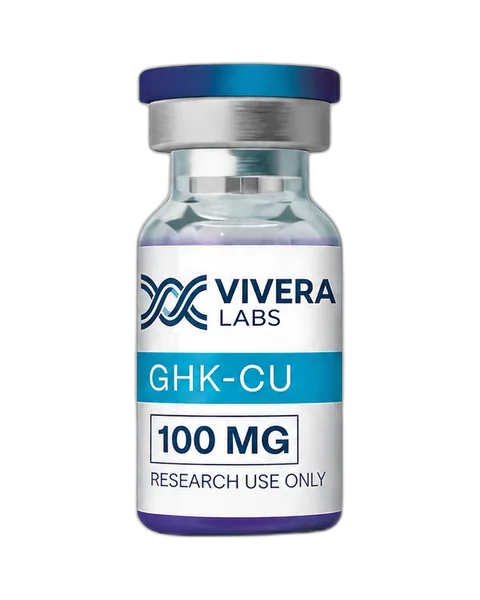
The biological activity profile reported in GHK-Cu research is highly concentration-dependent, with some studies observing opposing effects at supra-physiological versus nanomolar concentrations. This underscores the importance of verified compound purity and accurate concentration in all in-vitro experiments. Vivera Labs supplies GHK-Cu as a lyophilised powder with HPLC purity and mass spectrometry identity confirmed by an independent US-based third-party laboratory. Certificates of Analysis are available per batch on request. All material is supplied for in-vitro laboratory research use only.
Frequently Asked Questions What is GHK-Cu? GHK-Cu is the copper(II) complex of the tripeptide glycyl-L-histidyl-L-lysine (GHK), a sequence first isolated from human plasma albumin in 1973 by Loren Pickart. The free tripeptide binds cupric ions with high affinity, forming a stable square-planar coordination complex with a log stability constant of approximately 16.4. It is studied as a copper-binding tripeptide in in-vitro laboratory research.
How many genes does GHK-Cu interact with in research models? Transcriptome-wide analyses, including work drawing on the NIH LINCS database, have identified GHK-Cu as a modulator of over 4,000 human genes at the mRNA level when applied to human cell lines. The most enriched gene ontology terms include ECM organisation, response to oxidative stress, cell proliferation and apoptotic signalling. These emerge from computational analysis of in-vitro transcriptomic data and represent a research map rather than validated mechanistic conclusions.
What has in-vitro research shown about GHK-Cu and collagen? In-vitro human fibroblast studies have reported downregulation of MMP-1 and MMP-8 alongside upregulation of TIMP-1 and TIMP-2, suggesting a net matrix-protective shift in the MMP/TIMP ratio. Procollagen type I and type III synthesis, quantified by ELISA and hydroxyproline assay, has been shown to increase in dermal fibroblast models at nanomolar to micromolar concentrations. All such findings are from cell culture research systems for laboratory purposes only.
Why does GHK-Cu purity and concentration matter in research? The activity profile reported in GHK-Cu research is highly concentration-dependent, with some studies observing opposing effects at supra-physiological versus nanomolar concentrations, which makes verified purity and accurate concentration important in in-vitro experiments. Vivera Labs supplies GHK-Cu as a lyophilised powder with HPLC purity and mass spectrometry identity confirmed by an independent US-based third-party laboratory, with Certificates of Analysis available per batch on request. All material is supplied for in-vitro laboratory research use only.
Related
Continue reading
For in-vitro laboratory research use only. Not for human or veterinary use, consumption, or therapeutic application. No medical claims are made.