BPC-157 Peptide: What It Is and What the Research Shows
What BPC-157 is: the 15-amino-acid peptide GEPPPGKPADDAGLV, the cytoprotective and angiogenic pathways it is studied in, and what in-vitro research shows.
BPC-157 (Body Protection Compound-157) is a synthetic peptide composed of 15 amino acids (sequence GEPPPGKPADDAGLV). It is described in the literature as a partial sequence derived from a protein identified in human gastric juice. In the laboratory it is studied as a stable, water-soluble research peptide.
Structure and stability
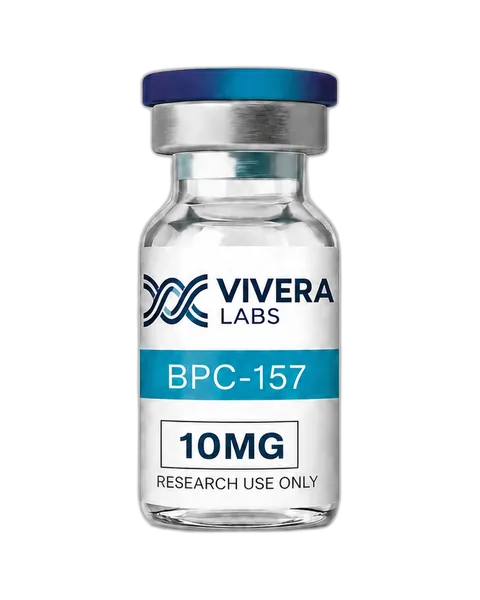
As a pentadecapeptide, BPC-157 is noted in the research literature for its stability in aqueous solution relative to many larger peptides. It is supplied as a lyophilised (freeze-dried) powder, which preserves the molecule during storage and transport; researchers reconstitute it with a suitable diluent under laboratory conditions.
What the research literature examines
Published in-vitro and in-vivo studies have investigated BPC-157 in the context of cytoprotection and angiogenesis-related signalling pathways. This body of work is exploratory and conducted in laboratory and animal models. Vivera Labs makes no claims regarding effects in humans; the compound is supplied strictly for in-vitro laboratory research.
Why purity matters for this peptide
For any research peptide, the validity of an experiment depends on knowing exactly what is in the vial. Truncated sequences, residual solvents, or counterion variation can all affect results. This is why each Vivera batch is independently tested by a US-based third-party laboratory, with a Certificate of Analysis available on request.
Identity confirmed by mass spectrometry Purity quantified by HPLC Batch-specific documentation USA-manufactured, cold-chain stored Read the research yourself
The most reliable way to understand any peptide is to read the primary literature. The references listed at the end of this article name the peer-reviewed primary sources behind it. We encourage researchers to evaluate the evidence directly rather than rely on summaries.
Frequently Asked Questions What is BPC-157? BPC-157 (Body Protection Compound-157) is a synthetic peptide composed of 15 amino acids, sequence GEPPPGKPADDAGLV. It is described in the literature as a partial sequence derived from a protein identified in human gastric juice, and in the laboratory it is studied as a stable, water-soluble research peptide.
What does BPC-157 research actually examine? Published in-vitro and in-vivo studies have investigated BPC-157 in the context of cytoprotection and angiogenesis-related signalling pathways. This body of work is exploratory and conducted in laboratory and animal models. Vivera Labs makes no claims regarding effects in humans; the compound is supplied strictly for in-vitro laboratory research.
Why does purity matter for a research peptide like BPC-157? For any research peptide, the validity of an experiment depends on knowing exactly what is in the vial — truncated sequences, residual solvents or counterion variation can all affect results. Each Vivera batch is independently tested by a US-based third-party laboratory, with identity confirmed by mass spectrometry and purity quantified by HPLC. A batch-specific Certificate of Analysis is available on request.
How is BPC-157 supplied and stored? It is supplied as a lyophilised (freeze-dried) powder, which preserves the molecule during storage and transport; researchers reconstitute it with a suitable diluent under laboratory conditions. Vivera batches are USA-manufactured and cold-chain stored.
Related
Continue reading
For in-vitro laboratory research use only. Not for human or veterinary use, consumption, or therapeutic application. No medical claims are made.